New Year Shock! China's Dual-Use Items Export Control to Japan Takes Effect, Japanese Shipbuilding Industry Faces "Lethal Impact"
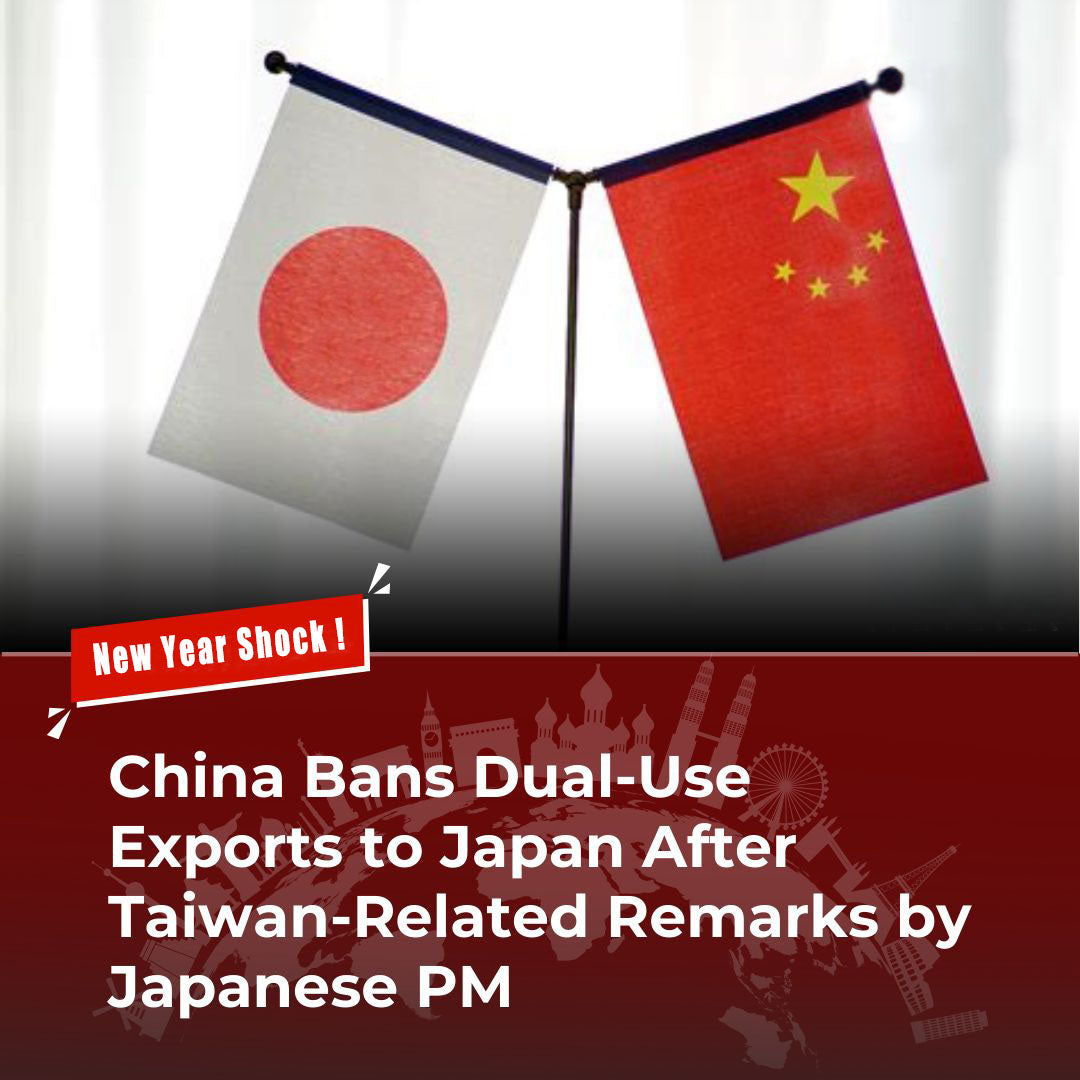
At the dawn of 2026, a heavyweight announcement from China's Ministry of Commerce shattered the calm in Japan's industrial sector. The No. 1 Announcement of 2026, issued on January 6, explicitly prohibits the export of all dual-use items to Japanese military users, for military purposes, or for any uses that contribute to enhancing Japan's military strength. It also strictly bans third-party re-export, with violators to be held legally accountable. This "New Year gift" without any grace period has precisely hit the Achilles' heel of Japan's industries highly dependent on China's supply chain. As the world's third-largest shipbuilding nation, Japan's shipbuilding industry, which relies heavily on China for core raw materials and key components, is bearing the brunt of a severe impact.

On January 12, 2026, Foreign Ministry Spokesperson Mao Ning hosted a regular press conference.
In the short term, Japan's shipbuilding industry will generally face the dual pressures of production disruptions and soaring costs. Japan's industrial sector adheres to the "just-in-time production" model, which demands extremely high supply chain stability. Related enterprises only maintain raw material inventories sufficient for short-term production, and resuming production capacity after core material shortages will take a significant amount of time. Meanwhile, China's control has blocked the circumvention channel of re-export trade. The announcement clearly states that organizations or individuals from any country or region that transfer relevant items to Japan will be held legally responsible, meaning Japanese enterprises cannot fill supply gaps through third-party channels. Japan's Ministry of Economy, Trade and Industry urgently launched the supercomputer "Fugaku" to simulate the consequences, and the results are alarming: if China cuts off the supply of relevant items worth about 1.4 trillion yen, Japan's overall production losses will soar to 53 trillion yen, and the shipbuilding industry, as a core link in high-end manufacturing, will be one of the hardest-hit sectors.
-
Mitsubishi Heavy Industries' shipyard in Kobe has taken the lead in halting operations. The launch of the new improved Soryu-class submarine, originally scheduled for March 2026, has been forced to delay due to the unavailability of key titanium alloy materials. The enterprise's procurement team sorted out the supply chain overnight, only to find that the vast majority of core materials are within the scope of control, with no alternative sources available in the short term.
-
Japan's flagship products such as LNG carriers and polar icebreakers require high-precision electronic components, magnetic materials for propulsion systems, etc., all of which fall into the category of dual-use items, and their production capacity release has been directly restricted.
-
In the field of basic materials such as steel, although Japan has a high self-sufficiency rate, the special additives required for high-end marine steel still rely on China. Complete "de-Sinicization" will mean a substantial increase in the total shipbuilding cost, and originally profitable orders may directly turn into losses.
In the long term, it will be extremely difficult for Japan's shipbuilding industry to restructure its "de-Sinicized" supply chain. Although Japan has previously promoted supply chain diversification, China's advantages in production capacity, technology, and cost in related material fields cannot be replaced in the short term. Sourcing alternative resources from countries such as Australia will cost more than 40% higher and can only meet 30% of the demand gap. From the perspective of industrial fundamentals, the supply chain lifeline of Japan's shipbuilding industry has been deeply bound to China. According to China's latest "Catalogue of Dual-Use Items and Technologies Subject to Import and Export License Administration," "ships and related equipment" themselves are clearly included in the control scope. Japan is heavily dependent on imports from China for key materials required for shipbuilding, from high-end materials to precision components.
-
Taking Mitsubishi Heavy Industries, a giant in Japan's military-industrial shipbuilding sector, as an example, nearly 70% of the high-end titanium alloy used in the production of submarine hulls in the first half of 2025 came from China; China is also the largest supplier of special welding materials and industrial bearings that support the operation of core ship equipment.
-
Regarding rare earths, a core dependency of the shipbuilding industry, Japan's import dependence on heavy rare earth elements such as dysprosium and terbium exceeds 90%, while 90% of the world's rare earth smelting and separation capacity is concentrated in China. Establishing a complete alternative supply chain will take at least 3-5 years, and production costs will rise by more than 60%.

On January 9, 2026, Japanese Prime Minister Sanae Takaichi attended a Cabinet meetingat the Prime Minister's Official Residence in Tokyo. Image source: VCG
This control adopts a "purpose-oriented supervision" model rather than the traditional "list-based ban"—as long as an item is deemed likely to help enhance Japan's military capabilities, even an inconspicuous screw may be included in the control scope. This has directly broken through Japan's industrial pride, the "just-in-time production" system. The "long-arm jurisdiction" clause in the announcement has completely blocked the re-export circumvention path. Countries such as Vietnam and Malaysia, which previously transshipped Chinese materials for Japan, have suspended relevant cooperation for fear of losing the Chinese market. Tokyo's decision-makers are left with only two paths: either continue to indulge in the old dream of reviving militarism, watching factories shut down due to lack of materials and orders become void due to breaches of contract, ultimately falling into an internal and external predicament. Objectively speaking, China's this control is not hegemonic pressure, but a reasonable countermeasure against Japan's recent provocative acts such as wrong remarks on Taiwan, increased defense spending, and promotion of the development of long-range offensive weapons.

Overall, China's launch of export controls on dual-use items to Japan during the New Year has dealt a "lethal blow" to Japan's shipbuilding industry. Short-term production stagnation is a foregone conclusion, and long-term development is limited by the high difficulty and high cost of supply chain restructuring, leaving the industry in a prolonged adjustment predicament. In the future, Japan's shipbuilding industry needs to find a new balance between cost control and compliant operations, and the global shipbuilding market share pattern may undergo subtle adjustments accordingly.
( Keywords: 2026 China dual-use items export control, Japan shipbuilding supply chain crisis, Mitsubishi Heavy shipyard production halt, marine titanium alloy supply restriction, Japanese naval vessel construction delay, LNG carrier manufacturing cost surge, Japan maritime industry de-Sinicization, dual-use materials shipping control, global shipbuilding market pattern shift, just-in-time production breakdown Japan shipbuilding)